
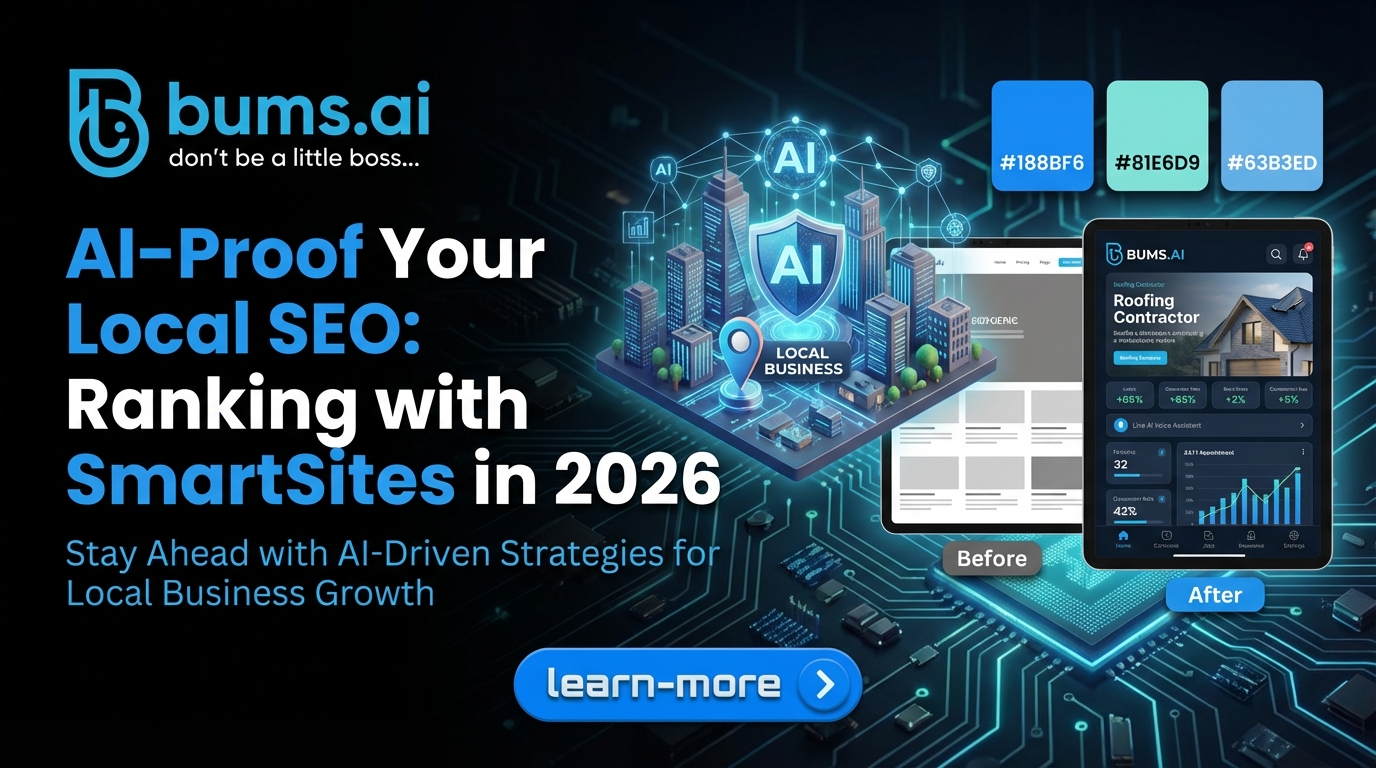
AI-Proof Your Local SEO: Ranking with SmartSites in 2026
AI-Proof Your Local SEO: Ranking with SmartSites in 2026
To AI-proof your local SEO in 2026, businesses must shift from traditional keyword targeting to entity-based mapping and agentic readiness. This involves optimizing for Generative Engine Optimization (GEO) by ensuring your website—specifically a high-performance SmartSite—provides structured data, sentiment-rich reviews, and real-time API connectivity that AI agents (like ChatGPT, Gemini, and Perplexity) can crawl and trust to make direct bookings or recommendations.
1. Introduction: The New Local SEO Paradigm (Why 2026 is Different)
The landscape of local search has undergone a seismic shift. In years past, local SEO was a game of keyword density, backlink quantity, and proximity. By 2026, the traditional "ten blue links" have been largely superseded by AI Overviews (formerly SGE) and direct responses from AI assistants. The goal is no longer just to be found; the goal is to be selected and transacted with by an AI agent acting on behalf of a consumer.
This evolution is driven by the rise of the Agentic Web. Users are no longer typing "plumber near me" into a search bar and browsing websites. Instead, they are telling their AI voice assistant, "Find a plumber who can fix a leak this afternoon, has great reviews for emergency work, and book the earliest slot." If your business data isn't structured for these AI models to parse instantly, you effectively do not exist in the local market. This is why AI-proof your local SEO strategies are now the baseline for survival.
Furthermore, the concept of Generative Engine Optimization (GEO) has replaced traditional SEO. GEO focuses on how Large Language Models (LLMs) cite sources. AI engines look for authoritative "entities"—businesses that have a clear, verified presence across multiple platforms with consistent data. To rank today, you must prove to the AI that your business is the most reliable and relevant solution for the user's specific, natural-language intent.
2. The SmartSites Philosophy: Search Everywhere Optimization (SEO 2.0)
At BUMS.AI, we advocate for the "SmartSite" philosophy—a departure from the static, brochure-style websites of the past. A SmartSite is an active participant in your sales funnel, designed specifically to feed AI search engines the high-fidelity data they crave. This is what we call Search Everywhere Optimization (SEO 2.0). It’s about being discoverable not just on Google, but on TikTok, Instagram, Perplexity, and Apple Intelligence.
A SmartSite serves as a centralized source of truth. By integrating your website directly with your CRM and AI Voice assistants, you create a feedback loop of real-time information. When a customer books an appointment via an AI voice bot, that data updates the SmartSite’s availability schema instantly. This "live" data signal tells search engines that your business is active and operational, which is a massive ranking factor for AI recommendation engines in 2026.
Finally, SmartSites prioritize the user experience through "Progressive Disclosure." AI engines track how users interact with your site after a search. If an AI agent sends a user to your site and the user immediately finds what they need—or better yet, interacts with an integrated AI chat to solve their problem—the AI engine marks your business as a high-quality result. This synergy between the website and AI automation is the core of ranking in the modern era.
3. Core Pillar 1: Transitioning from Keyword Matching to Entity-Based Mapping
Understanding the Local Knowledge Graph
AI models don't just see words; they see "entities." An entity is a distinct, well-defined object or concept—like your business. Entity-based mapping means moving away from trying to rank for "best Italian restaurant" and instead focusing on becoming the definitive Italian restaurant entity in your specific geography. This involves building a web of connections between your brand, your physical location, your staff, and your services in the eyes of the Google Knowledge Graph.
Defining Semantic Relationships
To AI-proof your local SEO, your content must emphasize relationships. For example, if you are a roofing company, your SmartSite should link your services to specific storm damage types, local building codes, and manufacturer certifications. These semantic connections help AI engines understand the depth of your expertise. By using clear, authoritative language and linking to reputable local sources, you solidify your place in the semantic web.
Establishing Topical Authority
Topical authority is earned by covering a subject so thoroughly that search engines view you as an expert. In a local context, this means creating content clusters that address every possible question a local customer might have. Instead of one "Services" page, a SmartSite utilizes dozens of micro-pages that answer specific long-tail queries, which AI engines then use as the primary source for their conversational answers.
4. Core Pillar 2: Optimizing Your Google Business Profile for AI Agents
GBP as the AI Data Powerhouse
Your Google Business Profile (GBP) is no longer just a listing; it is the primary data feed for Google’s AI Overviews. In 2026, AI agents rely on the "Attributes" section of your GBP to decide if you meet a user's specific needs. Are you "women-owned"? Do you have "wheelchair accessible seating"? Is there "free Wi-Fi"? AI-proofing your SEO means ensuring every single attribute is filled out and verified, as these become filters in AI-driven discovery.
Real-Time Inventory and Service Availability
One of the most significant shifts is the use of real-time data as a ranking signal. If an AI assistant is asked to find a "product in stock near me," it will prioritize businesses that have integrated their inventory with Google. For service businesses, this means integrating your booking calendar. A SmartSite from BUMS.AI does this automatically, signaling to AI agents that your business is ready for immediate transaction, which skyrockets your visibility in high-intent searches.
The Role of Visual Search Optimization
AI models are increasingly multi-modal, meaning they "see" images as well as read text. Optimizing your GBP photos with high-resolution, descriptive metadata allows AI engines to recommend your business based on visual cues. For instance, an AI might recommend a cafe because it identifies "quiet workspace" or "latte art" from the photos uploaded by the owner and customers, even if those words aren't explicitly on the page.
5. Core Pillar 3: Leveraging Sentiment-First Review Management Strategies
AI Analysis of Natural Language
In 2026, a 5-star rating is the bare minimum. AI engines now perform sentiment analysis on the text of your reviews to understand why people like you. They look for specific keywords like "punctual," "knowledgeable about heat pumps," or "fair pricing for small repairs." To AI-proof your local SEO, you must encourage customers to leave detailed, descriptive reviews that use natural language. These reviews act as primary training data for AI models recommending local services.
Specificity Over Volume
While review volume still matters, specificity is the new king. An AI engine is more likely to recommend a business with 50 highly detailed reviews about "emergency water damage restoration" than a business with 500 reviews that just say "great job." SmartSites leverage automated follow-ups via CRM to ask customers specific questions about their experience, nudging them to provide the semantic depth that AI algorithms prioritize.
Responding to Reviews for AI Context
Your responses to reviews are also crawled by AI. Use your responses to reinforce your business entities and services. Instead of saying "Thanks for the review!", try "Thanks for letting us help with your HVAC repair in [Neighborhood Name]; we take pride in being the go-to team for energy-efficient cooling in this community." This adds more location and service data to the AI's understanding of your business.
6. Technical Foundation: Structured Data and Agentic Workflow Readiness
Advanced Schema Markup for 2026
Schema markup is the language of AI. Beyond basic LocalBusiness schema, SmartSites utilize advanced nesting. This includes `Service` schema that defines the price, duration, and provider of a service, and `FAQ` schema that answers common questions. By providing this data in a structured format, you allow AI agents to extract information without having to "guess" by reading your paragraphs, making your site a preferred data source.
Preparing for Agentic Payments
The most advanced stage of AI-proofing is "Agentic Readiness." This refers to a website’s ability to allow an AI agent to complete a transaction. This requires secure, API-driven payment and booking gateways. When an AI can verify your price and book the appointment using a protocol like Web Payments, it is far more likely to recommend you to a user who wants an immediate solution. This is where BUMS.AI excels by bridging the gap between discovery and booking.
Privacy-First Data and Consent
As cookies disappear and privacy regulations tighten, AI models will rely more on "First-Party Data." SmartSites are designed to capture user consent and data directly, which can then be shared with AI assistants in a secure, privacy-compliant way. Businesses that can provide verified, consent-based data will be given priority in a "Zero-Party Data" search environment where trust is the ultimate currency.
7. Hyperlocal Mastery: Dominating Neighborhood Clusters Over Cities
The End of City-Wide Rankings
Ranking for a whole city is an outdated goal. AI is hyper-sensitive to proximity and neighborhood-level nuance. To AI-proof your local SEO, you need to dominate "neighborhood clusters." This means creating content that mentions specific landmarks, local events, and micro-locations. If an AI knows you are the "best roofer in Silverlake," it will prioritize you for users in that specific area over a generic city-wide competitor.
Geofencing Content and Micro-Locations
SmartSites utilize geofencing strategies by creating localized service pages that are dynamically served based on the user's location. By highlighting your work in specific subdivisions or business districts, you feed the AI's geographic intent engine. This localized depth proves that you are not just a business in the city, but a business active in the user's immediate vicinity.
Vertical-Specific AI Ranking Signals
Different industries have different AI ranking factors. For a local lawyer, AI prioritizes trust signals, credentials, and citations from legal directories. For a local cafe, AI prioritizes "vibe"—extracted from social media mentions, photo sentiment, and peak hour data. Understanding which signals the AI values for your specific vertical is a key part of the SmartSite strategy at BUMS.AI.
8. Measuring Success: Moving Beyond Clicks to AI Mentions and Direct Actions
Tracking Brand Mentions as Citations
In the AI era, a link is good, but a "brand mention" in an AI-generated answer is better. You must track how often your business is cited as a source by ChatGPT or Gemini. These citations are the new backlinks. If an AI says, "According to BUMS.AI, local businesses should...", that is a massive authority signal. SmartSites are built to be "quotable" by using clear definitions and authoritative data points that AI engines love to reference.
Attribution in a Zero-Click World
Success is no longer just about website traffic. In a zero-click world, the user might never actually visit your site; they might just book via the AI interface. You need to measure "Direct Actions"—calls, bookings, and directions—that originate from AI platforms. This requires a CRM sync that can attribute a phone call from an AI voice assistant back to the original search query, providing a true picture of your ROI.
Continuous Optimization and Feedback
AI-proofing is not a "set it and forget it" task. AI models are updated constantly. A SmartSite includes ongoing reputation management and content refreshes to ensure your data never becomes stale. By monitoring which aspects of your business AI engines are highlighting, you can double down on those strengths, ensuring you remain the top-recommended entity in your local market well into 2027 and beyond.
9. Conclusion: Future-Proofing Your Growth Strategy for 2027 and Beyond
The transition to an AI-first local search environment is inevitable. Businesses that continue to rely on 2020-era SEO tactics will find themselves invisible to the new generation of consumers who use AI agents to navigate the world. By adopting a SmartSite philosophy—focusing on entity-based mapping, structured data, and sentiment-rich authority—you aren't just ranking; you're building a resilient brand that AI engines trust.
Ultimately, ranking with SmartSites in 2026 is about being the most helpful and accessible option. When your business infrastructure is integrated with AI voice, CRM automation, and real-time data, you provide a level of service that search engines can't ignore. This is the ultimate way to AI-proof your local SEO: by becoming the most reliable entity in the digital and physical world simultaneously.
As we move toward 2027, the gap between the "digitally ready" and the "digitally stagnant" will only widen. Now is the time to audit your technical foundation, clean up your entity data, and invest in a website that works for you 24/7. With BUMS.AI, you aren't just preparing for the future; you're owning it.
Ready to Get Started?
BUMS.AI combines an AI voice, SmartSite widgets, and CRM sync to answer instantly, qualify prospects, and place appointments on your calendar—24/7.
Visit Our Homepage
